
Layla Jioussy
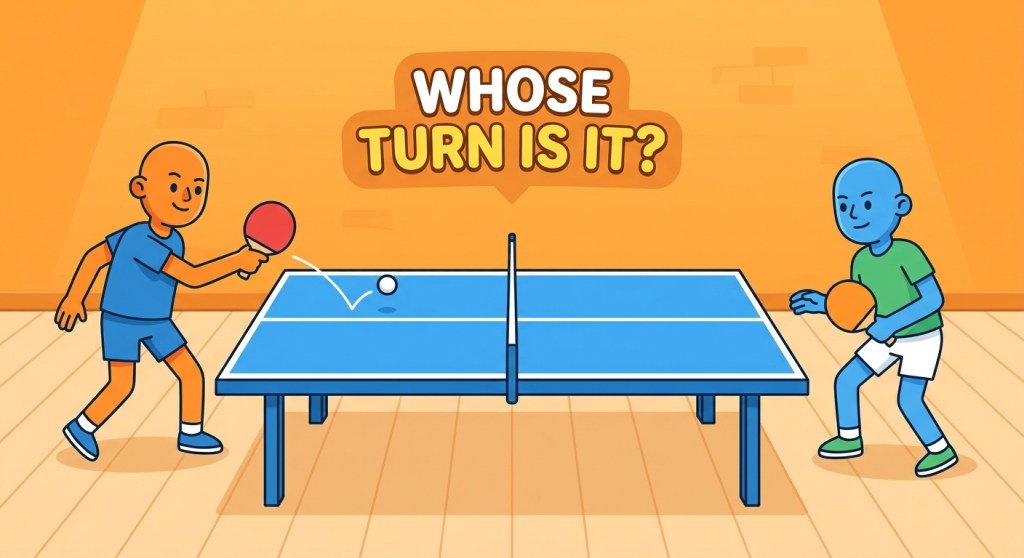
If you are ever playing ping pong recreationally, you probably know this situation. Me, my sister, and my dad play ping pong together a lot and it always runs smoothly until we finish a point and someone asks:
“Wait… Whose turn is it?”
Then we all start trying to remember who served last, who was supposed to serve next, and whether we already switched. And while sometimes we remember, we usually forget. And the funny part is that we end up spending almost as much time figuring out whose turn it is as we do actually playing ping pong.
Honestly, it doesn’t really matter for me because I always end up beating my sister anyways (jkjk).
The Mathematical Solution:
Imagine two players, Bob and Joe, are playing a match. The match starts at 0-0. Bob serves. Bob wins the first point, making the score 1-0. Bob serves again. Joe wins the next point, making it 1-1. Now they’ve played two points, so the serve switches to Joe because in ping pong, the serve changes every two points. So far, so good. The pattern keeps going.
1-2 → Bob
3-4 → Joe
5-6 → Bob
7-8 → Joe
9-10 → Bob
11 → Joe
Imagine the game gets going and the score is now 4-3. They’ve been talking, laughing, and neither player remembers who is supposed to serve. Instead of arguing about it for five minutes like most people do, they just use math. Here’s the important part: the sum of the two scores tells us exactly how many points have been played.
Bob looks at the score: 4 + 3 = 7
That means 7 total points have been played.
Since the server changes every two points, we can group those 7 points into pairs: 1–2 | 3–4 | 5–6 | 7
The first pair belongs to Bob, the second pair belongs to Joe, the third pair belongs to Bob, and now we’re in the fourth pair, which belongs to Joe. That’s why, the next step is to divide the sum by 2: 7 ÷ 2 = 3 remainder 1. We ignore the remainder (integer division) because we’re interested in how many complete pairs of points have passed. There have been 3 complete pairs, and after 3 switches, the serve is with Joe.
Every time another pair of points is completed, the server switches:
So if the number of complete pairs is even, we’re back to Bob. If it’s odd, we’re with Joe.
In the end…
If you are like my family until recently and just stand around trying to figure out who is serving next, just look at the score and use math to figure it out.
Just add, divide, and check: even or odd?
Who knew the solution to a ping pong argument would be math?
I hope you enjoyed learning about this tricky ping pong puzzle and I’ll see you in the next post!


Leave a comment