Layla Jioussy
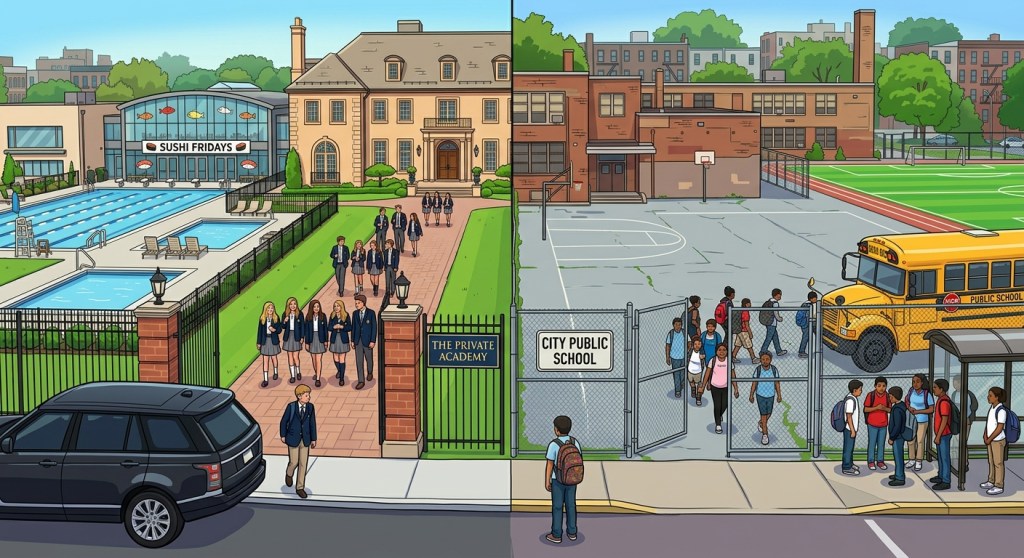
Imagine you are ten years old. You wake up for school, eat your breakfast, and get on the school bus, just like every other kid in the street. But one kid on your street doesn’t take the bus. On the way to school, you see him get dropped off in an SUV at a private school with two different types of pools, a full recording studio, and a top of the class dining hall that serves sushi on Fridays. You don’t even know what sushi is. And you wonder, how did that kid get those resources? Did he earn them? Or did he win a lottery at birth?
Hi, my name is Layla and today, I am here to argue that private schools should be banned. This is not because I have anything against rich people. This is because research shows us that private schools don’t just educate the wealthy, they instead make things worse for the rest of us. Even here in Palo Alto where there are some of the best public schools in the nation, people are still fighting to send their children to private schools. I can’t tell you I could be a professor on this, but the research I did comes from professionals at Yale, Princeton, the Brookings institution, and academic journals. So while I’m just a student standing in front of you, the people behind these arguments are not.
Maybe you think this is someone else’s problem but every dollar that goes into a private school voucher program comes out of your school’s budget. And while you might think, “Wait, aren’t voucher programs good?” Well, they make themselves seem like heroes but actually only give vouchers to the rich, ineligible applicants; but we’ll get to that later. Every time a high-income family leaves the public system, they take their tax dollars, influence, and community investment with them. This is your classroom. Your textbooks. Your teachers.
The most common argument for private schools is that they create more educated people. But do they really? Let’s make up a kid. Alex. Alex lives in Indiana and his family has been saving up for his education since before he was born. The state had just expanded the private school voucher program to give every kid a chance at private school. Alex’s family applied. He was accepted and spent a year in private school. Researchers studying Indiana’s voucher program found that students like Alex who used the voucher program had lower math test scores than their public school peers and the gap “persisted regardless of the length of time spent in a private school.” In response to this, his private school raised their tuition by 25% because, well, why not? They could. Eventually, Alex went back to public school because his family couldn’t afford this anymore. But the school he went back to had even less than before he left. This isn’t a success story, it’s a system going wrong.
A study in 2018 by researcher Robert Pianta that dove deeper into social, physiological, and academic factors reported that the student success is not because of the school type but rather having personal advantages, such as college-educated parents and higher household incomes. Private schools aren’t magic. They are just filled with kids who are already doing well. College Board data from 2024 reports that on the SAT, students who scored higher were of families with higher income than students who scored lower. The test isn’t measuring school quality. It’s measuring wealth. So when private schools point to their impressive test scores and say “look how good we are,” they are just using privilege to justify privilege.
Well, shouldn’t there be a way voucher programs could work? That’s a great idea, if only the wealthy would stop abusing it for their own benefit. A study in Arizona by researchers at Brookings Institution found that the wealthiest 10% of the state were five times more likely to use the voucher program than the poorest 10%. Five times. Then there’s North Carolina. When the voucher program was first introduced in 2014, more than half of the recipients were Black. Today, that number has dropped to about 17% because the majority of voucher users are high-income white families whose children are already enrolled in private schools. And here’s the crazy part, private schools taking part in voucher programs are not obligated to follow the same academic standards, civil rights protections, and accountability measures as public schools. So basically, our tax money is going to these institutions that aren’t answering to the public.
Now, here’s something you probably didn’t know, the private system in America has racist roots. After Brown v. The Board of Education in 1954, congress ruled segregation of public schools unconstitutional. This integration upset white lawmakers in the south and they wanted a way around it. They quickly realized that this ruling only applied to public schools so they created private schools known as “segregation academies” and “freedom of choice” plans which are very early versions of voucher programs. Taking this move allowed for these lawmakers to be able to cherry pick their applicants. They did this to allow white families of all incomes to leave newly integrated public schools and come to these all-white private schools. Now, the tool has changed. But the effect hasn’t. Activist Nadine Smith put what voucher programs do into simple words, “They’re a scheme to defund public schools, to funnel taxpayer dollars to unaccountable private institutions, and leave Black children and working families with fewer resources and fewer opportunities.”
There is a reason public schools are sometimes called the “great equalizer.” They bring kids from completely different backgrounds and put them in the same learning environment. Data from 22 affluent democracies shows that public education spending consistently lowers income inequality. In contrast, higher levels of private education spending are associated with greater income inequality. Public systems are known to be more efficient at raising the skill level of the entire population which drives broader economic growth than elite focused private systems. W.E.B. Du Bois said in 1905, “When we call for education we mean real education… Education is the development of power and ideal.” That was over a hundred years ago. We are still fighting the same fight.
Let me bring this back to where we started. The kid in the SUV and the kid on the bus. Education is not a product. The private school system has been taking our money and resources from the schools that actually serve the majority. The kid in the SUV and the kid on the bus live on the same street. They will work in the same economy, vote in the same elections, and contribute to the same country. We can either build schools that can reflect that shared future, or we can keep writing checks to institutions that answer to only the few. I know which one I choose. Thank you.
Álvarez, Brenda. “The Racist Beginnings of School Vouchers.” neaToday, 13 Feb. 2026. neaToday, http://www.nea.org/nea-today/all-news-articles/racist-beginnings-school-vouchers. Accessed 28 Apr. 2026.
Claybourn, Cole. “Private School vs. Public School.” U.S. News & World Report, vols. Aug. 19, 2025, 19 Aug. 2025. U.S. News & World Report, http://www.usnews.com/education/k12/articles/private-school-vs-public-school. Accessed 28 Apr. 2026.
Gasoi, Emily, and Deborah Meier. “To Strengthen Democracy, Invest in Our Public Schools.” American Federation of Teachers, spring 2018. American Federation of Teachers, http://www.aft.org/ae/spring2018/gasoi_meier. Accessed 3 May 2026.
Huber, Evelyne, et al. “Private education and inequality in the knowledge economy.” Taylor & Francis Online, 1 July 2019, pp. 171-88. Taylor & Francis Online, http://www.tandfonline.com/doi/full/10.1080/14494035.2019.1636603#abstract. Accessed 1 May 2026. Abstract.
Lieberman, Mark. “Private School Choice: What the Research Says.” EducationWeek, 10 Oct. 2024. EducationWeek, http://www.edweek.org/policy-politics/private-school-choice-what-the-research-says/2024/10#:~:text=But%20more%20recent%20examinations%20of,a%20similar%20hit%2C%20researchers%20found. Accessed 28 Apr. 2026.
Zimmerman, Seth. “Century-Old Harvard Records Show How Social Connections Help the Elite.” Yale Insights, 14 June 2021. Yale Insights, insights.som.yale.edu/insights/century-old-harvard-records-show-how-social-connections-help-the-elite. Accessed 1 May 2026.
 HOME | Walkwithlayla
Leave a comment